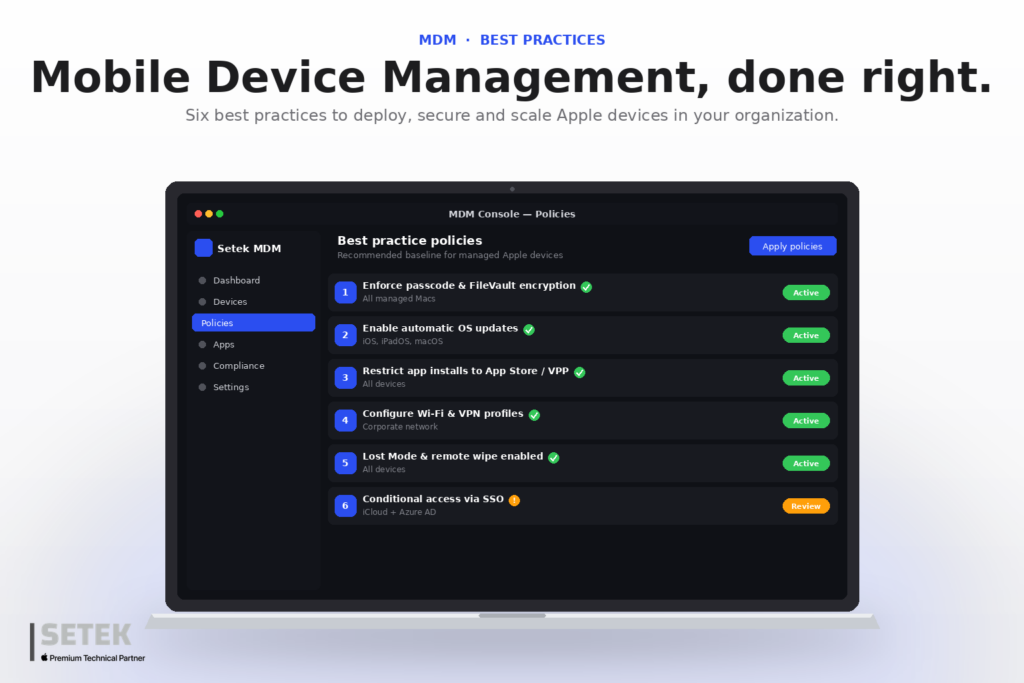
7 MDM Best Practices for Apple Devices: The Definitive Guide for Businesses
Mobile Device Management (MDM) is a cornerstone of any modern organization’s digital strategy — particularly for businesses operating across Spain, Dubai, Abu Dhabi and the wider GCC region, where hybrid workforces and rapid scaling are the norm. Achieving an effective MDM implementation involves far more than deploying a tool: it demands a clear strategic vision, robust policies and continuous governance.
In this article we explore the 7 MDM best practices that guarantee quality control over your devices and corporate data, reduce operational risk and unlock real scalability across your Apple fleet. If you are still choosing the right platform, our complete guide on the best MDM solution for Apple businesses will help you compare the leading options.
1. Assess the maturity of your MDM strategy: the critical starting point
Before defining any action plan, it is essential to understand where your organization stands today. Evaluate the maturity of your MDM program across three dimensions:
- Device and policy coverage. Are you managing every iPhone, iPad and Mac across the company, or only a subset of critical endpoints? Have you mapped BYOD vs corporate-owned scenarios?
- Operational capacity. Does your current MDM allow you to scale without friction? Are provisioning and policy enforcement automated, or are your IT teams still touching devices one by one?
- Business alignment. Does MDM respond to real organizational objectives — productivity, security, compliance — or is it perceived as a purely technical obligation?
If manual provisioning is slowing you down, our article on Zero-Touch Deployment for Apple devices explains how to roll out hundreds of devices without ever physically configuring them.
2. Design MDM policies aligned to business objectives
A solid MDM policy must clearly define:
- Permitted device types (BYOD vs corporate-owned vs COPE).
- Authorized and restricted applications, with category-based allow/deny lists.
- Encryption (FileVault on Mac, Data Protection on iOS), remote lock and selective wipe.
- Update and patch cadence, including managed software updates and rapid security responses.
- Identity lifecycle: onboarding, role changes, offboarding and device retirement.
For organizations in the UAE, policy design must align with the UAE National Cybersecurity Strategy and ADHICS standards. In Spain, policies must respect the GDPR and the Spanish LOPDGDD framework.
3. Governance and control: the foundation of effective device management
Strong governance turns MDM from a tactical tool into a strategic capability:
- Role-based access control (RBAC). Separate duties between device administrators, security officers, content managers and auditors.
- Documented business rules. Define validation logic, approval workflows and exception handling for policy deviations.
- Audit and traceability. Record who modified what, when and why — a non-negotiable for ISO 27001, SOC 2 and UAE IA compliance audits.
4. Automation and scalability: practices that eliminate bottlenecks
Manual operations do not scale. To support growth across multiple offices and emirates:
- Automate device provisioning through Apple Business and Automated Device Enrollment (ADE).
- Apply smart group-based policies driven by department, location or device posture — never per individual user.
- Establish automated quality gates: certificate renewal, compliance checks, jailbreak detection and stale-device cleanup.
- Integrate with your identity provider (Microsoft Entra ID, Google Workspace, Okta) for federated authentication and conditional access.
Apple’s official documentation on Apple at Work is the reference source for the latest deployment capabilities.
5. Integration with your IT and business ecosystem
MDM should not live in isolation. To maximize value, integrate it with the rest of your stack:
- Bidirectional flows with ITSM platforms (ServiceNow, Jira Service Management, Freshservice) for incident, asset and request management.
- Certified APIs and connectors to your CRM and HRIS — no fragile, ad-hoc scripts.
- Synchronization of critical attributes such as employee ID, department, location and account status.
- SIEM integration (Splunk, Microsoft Sentinel, Elastic) for centralized security telemetry.
6. Security and regulatory compliance
Security is the heart of any MDM program. The must-haves are:
- Encryption at rest and in transit across all managed endpoints.
- Multi-factor authentication (MFA) for both administrators and end users.
- Event logging, behavioral analytics and automated alerting.
- Data retention, anonymization and deletion policies aligned with the GDPR, the UAE Federal Personal Data Protection Law (PDPL) and ADHICS.
- Zero Trust principles applied to every connection request.
For a deeper dive into the current threat landscape, read our analysis on how to protect your Apple devices in 2026 with cybersecurity, MDM and AI.
7. Lessons learned: the most common errors and how to avoid them
After hundreds of deployments across Spain and the UAE, the patterns that derail MDM projects are remarkably consistent:
- Underestimating cultural change. End users need clear communication, training and support — especially when moving to supervised mode.
- Vague policies. Ambiguous standards generate non-compliance and shadow IT.
- Excluding the business. MDM is not just an IT matter; it is a productivity and risk lever that requires sponsorship from leadership.
- Skipping data hygiene before migration. Garbage in, garbage out — clean your inventory and identity data before onboarding into a new platform.
- Ignoring the user experience. Overly restrictive policies push users to find workarounds. Balance security with usability.
A well-executed MDM strategy not only protects your digital assets — it accelerates onboarding, raises data quality, and improves the experience of every employee using an iPhone, iPad or Mac at work.
“As a technology consultant, I have seen how a strategic MDM implementation can make the difference between a robust infrastructure and one that wobbles with every change. The true power of Mobile Device Management does not lie in the tool, but in how you align it with your objectives, your business culture and your technology ecosystem. Those who understand this do not just manage better — they lead change.” — Jero Schwab
Let SETEK design and operate your MDM strategy
As an Apple Premium Technical Partner serving organizations across Spain, the UAE and the wider GCC, SETEK delivers end-to-end MDM services: platform selection, Apple Business setup, policy design, zero-touch rollouts, integrations and ongoing managed services. Discover our real customer stories and see how we help businesses transform the way they work with Apple.
Schedule your free consultation HERE.