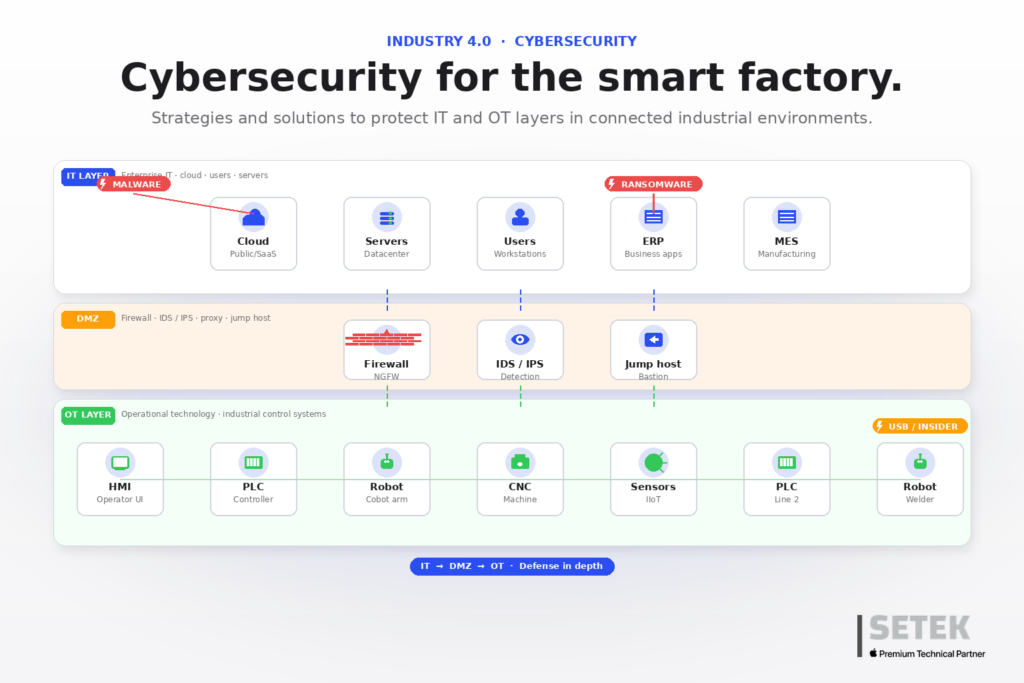
Industry 4.0, driven by digital transformation and the proliferation of connected devices, has redefined modern industrial processes. However, this technological evolution has exponentially increased cyber risks. This article analyses current cybersecurity challenges in Industry 4.0, presents effective protection strategies and reviews evidence-based technology solutions.
Industry 4.0 represents a convergence of emerging technologies such as the Internet of Things (IoT), artificial intelligence (AI), cyber-physical systems (CPS) and Big Data. This digital industrial revolution, while promising, has exposed critical infrastructure to unprecedented cyber threats.
Cyber risks and threats in industrial environments
Connected devices and attack surface
The growing connectivity of sensors, actuators and smart machines creates a vast attack surface. According to an ENISA (2023) report, 62% of European manufacturing companies have been victims of cyber incidents linked to IoT.
The most relevant threats include: Ransomware: encryption of critical industrial systems in exchange for financial ransoms; DDoS attacks: paralysis of SCADA systems; Operational data manipulation: alteration of industrial parameters with physical consequences.
Effective cybersecurity strategies
- Security by design: integrating cybersecurity from the design phase of industrial systems.
- Zero Trust model: promoting the “never trust, always verify” principle, limiting attackers’ lateral movement.
- Continuous risk assessments: applying methodologies like NIST Risk Management Framework or ISO/IEC 27005.
Notable technology solutions
- Network segmentation with industrial firewalls: technologies adapted to OT protocols (Modbus, DNP3).
- IDS/IPS monitoring systems: tools like Snort or Zeek adapted to industrial networks.
- Automated asset and patch management: platforms like Claroty, Nozomi Networks or Tenable.ot.
The importance of the National Security Scheme (ENS)
Implementing the ENS is not only a legal requirement for many public sector contractors, but also a strategic opportunity to strengthen enterprise cybersecurity, protect digital assets and build trust with clients and partners.
If you are using Apple devices in your industrial infrastructure, Jamf Protect offers essential features to reinforce security.
Case studies and results
- Siemens: Implementation of a Zero Trust-based approach at its Amberg plant resulted in a 90% reduction in detected unauthorised accesses.
- Honeywell: Through its Cyber Insights solution, it reduced the mean time to detect incidents from 14 days to less than 6 hours.
Cybersecurity in Industry 4.0 is an essential component of digital transformation. Organisations must adopt a comprehensive approach, combining cybersecurity strategies with specific technology solutions to protect against growing cyber threats.
Take advantage of our free first consultation and book now