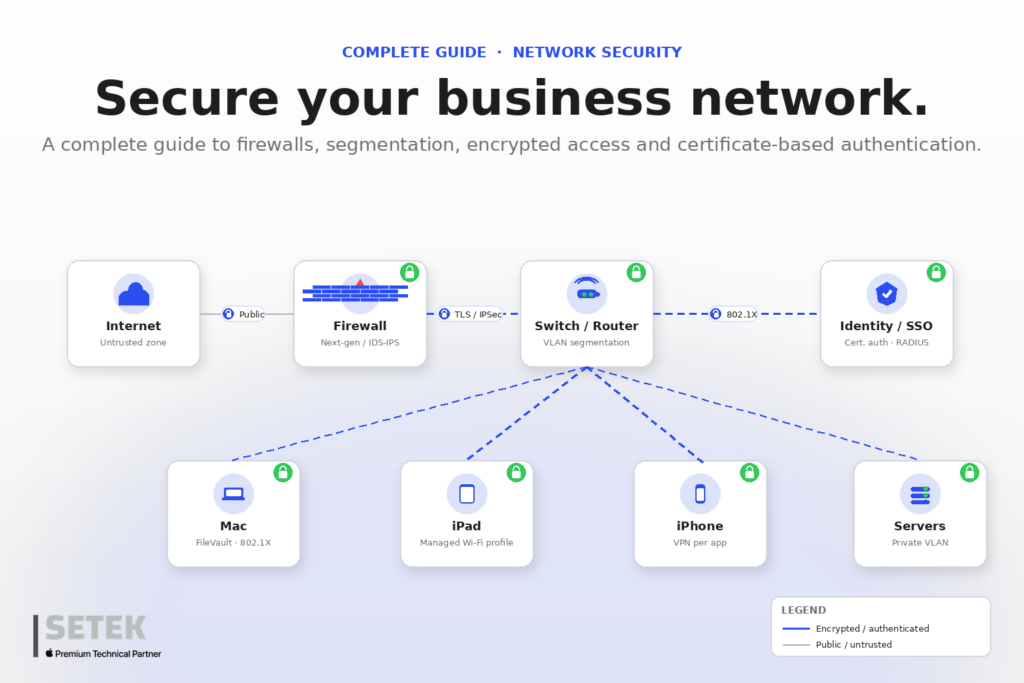
Designing and operating a secure network is no longer optional — it is a critical requirement for any modern organization. With the rise of hybrid work, personal-device adoption (BYOD), the explosion of IoT endpoints and the increasing regulatory pressure across the UAE, Dubai, Abu Dhabi and Spain, network security is the foundation that protects your assets, data and day-to-day operations.
In this guide we explain why enterprise network security must be a board-level priority, how to design a resilient architecture, which protocols and controls really matter, and when it is time to bring in external specialists like SETEK to take ownership of the entire stack.
Why network security is mission-critical for today’s enterprise
Network security has moved from being an IT line item to one of the top business risks for any organization. The most common breach vectors we see at SETEK across deployments in the UAE and Spain include:
- Weak, reused or uncontrolled shared passwords across teams and service accounts.
- Endpoints, switches and access points running outdated firmware or unpatched operating systems.
- Flat networks with no segmentation, no micro-segmentation and no granular access policies.
- Unmanaged BYOD devices — personal iPhone, iPad and Mac — connecting to corporate Wi-Fi without enrollment in an MDM platform.
- Shadow IT, rogue cloud services and exposed APIs with no centralized inventory.
For organizations operating in the Emirates, these risks are compounded by the requirements of the UAE National Cybersecurity Strategy, the UAE Information Assurance Standards and ADHICS for healthcare. In Spain, the regulatory baseline is set by the Esquema Nacional de Seguridad (ENS), the GDPR and the LOPDGDD.
Secure enterprise network architecture: the foundational principles
A truly secure network is not built from a single appliance — it is the result of layered design choices. The non-negotiable principles are:
- Network segmentation and micro-segmentation. Separate critical workloads (servers, finance, OT/IoT) from general traffic, and enforce east-west controls between segments.
- Zero Trust. Trust nothing by default; verify every user, device and connection request continuously. The NIST Zero Trust Architecture (SP 800-207) is the international reference framework.
- Redundancy and high availability. Active-active firewalls, redundant uplinks, multiple ISPs and resilient DNS to keep operations running through any single failure.
- Centralized device management. Every iPhone, iPad and Mac enrolled through Apple Business and an MDM for consistent posture and policy.
- Secure protocols and strong encryption. Modern cipher suites, no legacy fallbacks, and certificate-based authentication wherever possible.
- Role-based and attribute-based access policies. Least privilege as the default, reviewed quarterly.
Key protocols and configurations for a hardened network
The technical baseline that every business in the UAE or Spain should already have in place:
- Encryption in transit with TLS 1.3 and AES-256 across all internal and external traffic.
- HTTPS enforced everywhere, including internal admin panels, with HSTS and certificate pinning where supported.
- Enterprise VPN or SASE/ZTNA for remote access — no split tunneling for sensitive workloads.
- Wi-Fi protected with WPA3-Enterprise, never WPA2-Personal in a corporate environment.
- 802.1X with RADIUS for network access control on both wired and wireless segments, integrated with your identity provider (Microsoft Entra ID, Google Workspace, Okta).
- Password managers with MFA and policies for periodic credential rotation, secrets management and privileged access.
- DNS filtering and secure resolvers to block command-and-control traffic and known-malicious domains.
For Apple-centric environments, Apple’s Platform Security Guide is the authoritative reference for built-in cryptographic protections across iPhone, iPad and Mac.
Protection layers: firewall, monitoring and access control
A defensible network combines prevention, detection and response:
- Next-generation firewall (NGFW). Application-aware policies, IPS, TLS inspection and threat intelligence feeds.
- Intrusion Detection and Prevention Systems (IDS/IPS). Continuous inspection of north-south and east-west traffic.
- Identity-driven access control. Resource access governed by user profile, device posture, location and risk score.
- 24/7 network monitoring and SIEM. Centralized telemetry with platforms such as Microsoft Sentinel, Splunk or Elastic, paired with a SOC capability.
- EDR/XDR on every endpoint. Including Mac, iPhone and iPad fleets enrolled in MDM.
- Vulnerability management. Regular scanning, prioritized remediation and patch SLAs.
For a deeper view of the threat landscape across Apple environments, read our analysis on how to protect your Apple devices in 2026 with cybersecurity, MDM and AI.
Expert recommendations and the most common errors to avoid
After hundreds of deployments across Spain, the UAE and the wider GCC, the patterns that derail network security programs are remarkably consistent:
Common errors
- Relying solely on the perimeter firewall while leaving the internal network flat and trusting.
- Forgetting to update router, switch and access-point firmware.
- Failing to revoke credentials and certificates for ex-employees and ex-contractors.
- Treating BYOD as a checkbox instead of enforcing posture through MDM.
- Not testing the incident response plan — or not having one at all.
SETEK recommendations
- Run a full network and posture assessment at least every six months.
- Enroll every Apple device in MDM and apply zero-touch provisioning to remove human error from onboarding (see our guide on Zero-Touch Deployment).
- Document every architectural decision, change and exception — auditors will ask for it.
- Test backups and disaster recovery procedures quarterly, not annually.
- Embrace Zero Trust as a roadmap, not a single project.
When is it time to bring in external cybersecurity specialists?
There are clear signals that your organization needs external expertise:
- Suspicious access attempts outside business hours, or anomalous geographies for known accounts.
- Recurrent network slowdowns, packet loss or unexplained outages.
- An internal IT team without dedicated security or Apple-specific knowledge.
- Compliance obligations or certifications (ISO 27001, SOC 2, ADHICS, ENS, PCI DSS) that are not being met.
- A recent merger, office expansion across emirates, or a shift to hybrid work that has outgrown the existing network.
Let SETEK secure your network end to end
At SETEK Consultants, Apple Premium Technical Partner serving organizations across the UAE and Spain, we design, deploy and operate secure enterprise networks — from initial assessment and architecture, through implementation of NGFW, Wi-Fi, VPN/ZTNA and MDM, to continuous monitoring and managed cybersecurity services. Explore our real customer stories to see how we help businesses transform their security posture.
Contact us today and protect your network before it is too late.