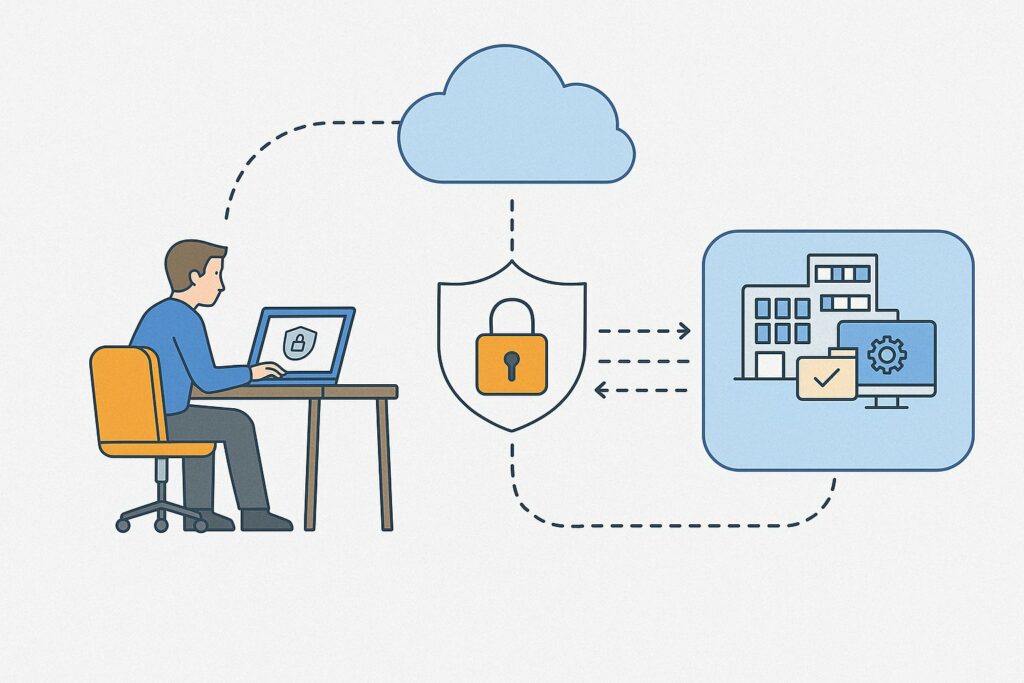
Secure remote access has become an imperative for modern organisations. In an environment where hybrid work and digital threats are growing exponentially, ZTNA (Zero Trust Network Access) stands out as the most effective solution. Compared to traditional models like VPNs, ZTNA offers a more robust, dynamic and security-centred approach.
What exactly is ZTNA and how does it differ from a VPN?
ZTNA is an access model based on a key principle: never trust, always verify. Unlike a VPN, which gives broad access to the entire network once the user authenticates, ZTNA provides segmented access limited only to authorised resources, applying granular and continuous controls.
- Segmented vs. total access: ZTNA allows users to access only the applications they need, without exposing the entire network.
- Continuous evaluation: ZTNA analyses the context of each connection (location, device, time) and applies dynamic policies.
- Smaller attack surface: Resources are not publicly visible, reducing exposure risk.
How the Zero Trust model works for remote access
- Multi-factor authentication (MFA): To validate user identity.
- Device assessment: Analysis of whether the device meets security policies.
- Context control: Location, network, user behaviour reviewed before granting access.
- Granular policies: Defining what resources each user can see and use.
- Continuous monitoring: Each session is monitored in real time with ability to cut access at any anomaly.
Main advantages of ZTNA for enterprise security
- Reduced breach risk: By hiding resources and requiring continuous validation.
- Personalised access: Each user only sees what they need.
- Protection for hybrid environments: Ideal for companies with remote or mobile workers.
- Integration with cloud security solutions: DLP, CASB and next-generation firewalls.
- Optimised user experience: Avoiding VPN bottlenecks.
Use cases: when does ZTNA make sense
- Remote and hybrid work: secure access without compromising user experience.
- Third-party or contractor access: limited, controlled access to specific resources.
- Cloud migration: ZTNA adapts perfectly to multi-cloud architectures.
- Protection of critical applications: restricts access to CRM, ERP or financial systems.
- Regulatory compliance: GDPR, ISO 27001, NIS2.
Keys to deploying ZTNA effectively
- Assess the current environment: identify critical applications, users and flows.
- Select an appropriate ZTNA solution compatible with your cloud and hybrid environments.
- Apply Zero Trust policies gradually, starting with the most sensitive accesses.
- Train the IT team and users.
- Monitor and adjust continuously.
ZTNA, SASE and beyond
ZTNA increasingly forms part of broader architectures like SASE (Secure Access Service Edge), combining ZTNA for secure remote access, SWG (Secure Web Gateway) for protected browsing, CASB for SaaS application control, and SD-WAN for optimised connectivity.
Implementing ZTNA takes secure remote access to the next level, aligned with the Zero Trust model and current security challenges.
Ready to implement ZTNA in your company? At SETEK we help you design and implement a ZTNA-based secure remote access strategy adapted to your real business needs. Contact SETEK and transform your remote access security today.