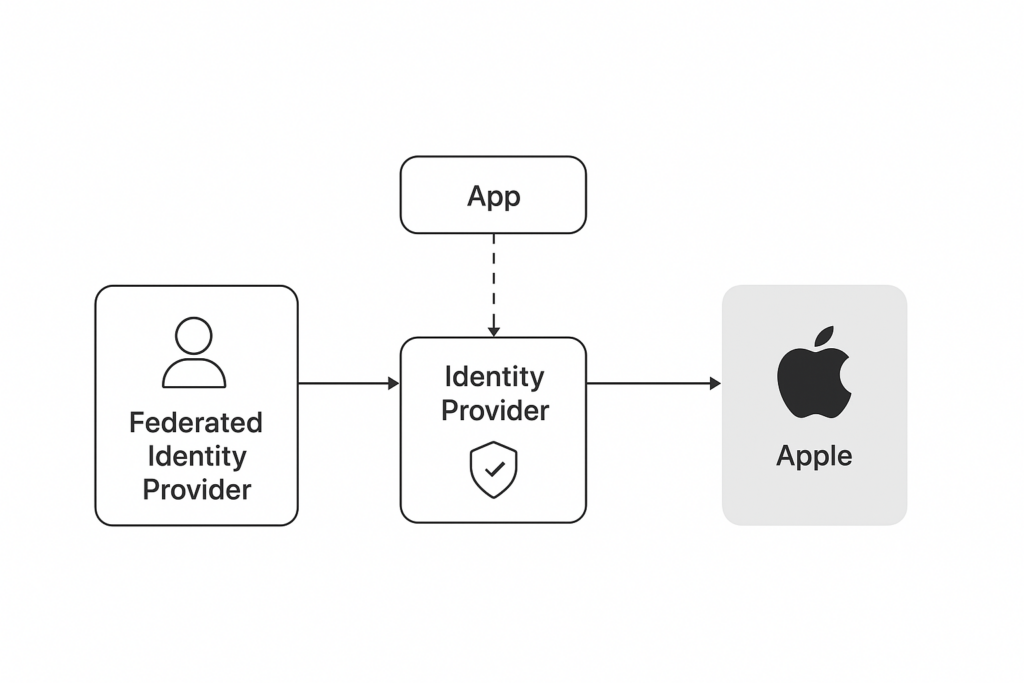
In the current context of digital transformation, identity management and access control with Apple are becoming strategic pillars of enterprise Apple security. In this article, Setek Consultants explores why these disciplines are gaining increasing prominence, how Apple’s solutions contribute, and what concrete steps your company can take to implement them efficiently.
Why identity management is key today
Identity management has become an essential pillar of security strategy. With employees accessing from various devices, external parties, hybrid work environments and cloud services, the challenge is no longer simply “who is inside the network” but “how do we identify who is accessing, from which device, with what context, and what are they doing?”
- Identities have become attackers’ preferred entry point: stolen credentials, improper access and poorly managed privileged accounts are recurring vectors.
- Regulatory directives like NIS2 require organisations to implement strong access controls, segmentation, least-privilege, reinforced authentication and audit trails.
- With devices from different manufacturers, cloud services and mobile environments, there is a need for uniform identity and access management regardless of OS or manufacturer.
- In enterprise Apple security, it is vital that Apple devices are not isolated islands without identity, access and authentication controls.
Apple solutions for access control
Managed Apple Accounts / Apple Identity Services
Apple’s platform offers identity services that allow management of enterprise accounts, passwords, authorisations and federation. It enables users to use a single identity (their corporate email address) to access iPhone, iPad, Mac, etc., facilitating user experience and reducing friction.
Single Sign-On (SSO) and federated authentication
Apple has included an integrated SSO framework in its corporate devices. Apple Business Manager enables identity federation with external providers like Microsoft Entra ID via OpenID Connect (OIDC) or SCIM. After federation, users can use their credentials to register enterprise Apple devices, with Apple Enterprise SSO integrating with Microsoft’s identity system.
Device and resource access management
Organisations can define how and from where accounts can be used (e.g., on managed or supervised devices) and what services are available. This allows access control policies based on device state, user role and usage context. The control is not just “correct user?” but “user + device (management) + context + resource?”
Apple Business Essentials and integration with external services
Apple Business Essentials (ABE) is an all-in-one platform for small and medium businesses that unifies device management, identity management and iCloud services. Key features include federated authentication allowing users to use their existing corporate identity (Microsoft Entra ID or Google Workspace) to access Apple devices, and SCIM/OIDC directory synchronisation.
Recommendations from Setek
- Start with a clear inventory: What Apple devices do you have? What identity providers do you use? What users need access?
- Define roles and access policies: Who are administrators? What privileges do they need?
- Identity federation: If you use Microsoft Entra ID or Google Workspace, consider federating with Apple.
- Device access controls: Ensure Apple devices are managed (MDM) and apply policies.
- Audit and compliance: Implement access logging, account reviews and orphaned account cleanup to comply with frameworks like NIS2.
In a world where digital infrastructure is increasingly distributed, identity management, access control and Apple enterprise security are no longer isolated modules but key components of the overall security strategy.
Want us to prepare a personalised plan for your company? Book your free consultation